Union Connect: Three capital market challenges — insights for building more resilient portfolios

|
|

|
|
Geopolitics, interest rates and AI concentration are putting institutional portfolios to the test. Which risks are already priced in – and where are opportunities opening up? Tobias Schmidt, Head of Portfolio Management at Union Investment, explains how active management can strengthen portfolio resilience.
Tobias, how should investors deal with geopolitical crises, given that there are currently so many of them?
Tobias Schmidt: Investors should not try to predict geopolitical crises – they should prepare their portfolios for them. This means, first and foremost, staying calm during volatile periods and not reacting hastily to every political headline. Many geopolitical events only move markets in the short term. Structural geopolitical shifts, however, can shape economies and financial markets for years.
Precisely because such risks and their consequences are difficult to forecast, consistent scenario management is essential. Potential transmission channels and portfolio effects should be analysed at an early stage – including scenarios with a low probability but potentially significant impact.
At the same time, portfolios should be positioned robustly across a range of possible developments. Broad diversification alone is not enough: what matters is having different sources of return that are as uncorrelated as possible.
Precisely because such risks and their consequences are difficult to forecast, consistent scenario management is essential. Potential transmission channels and portfolio effects should be analysed at an early stage – including scenarios with a low probability but potentially significant impact.
At the same time, portfolios should be positioned robustly across a range of possible developments. Broad diversification alone is not enough: what matters is having different sources of return that are as uncorrelated as possible.
Capital market volatility remains subdued
Bond market volatility below average
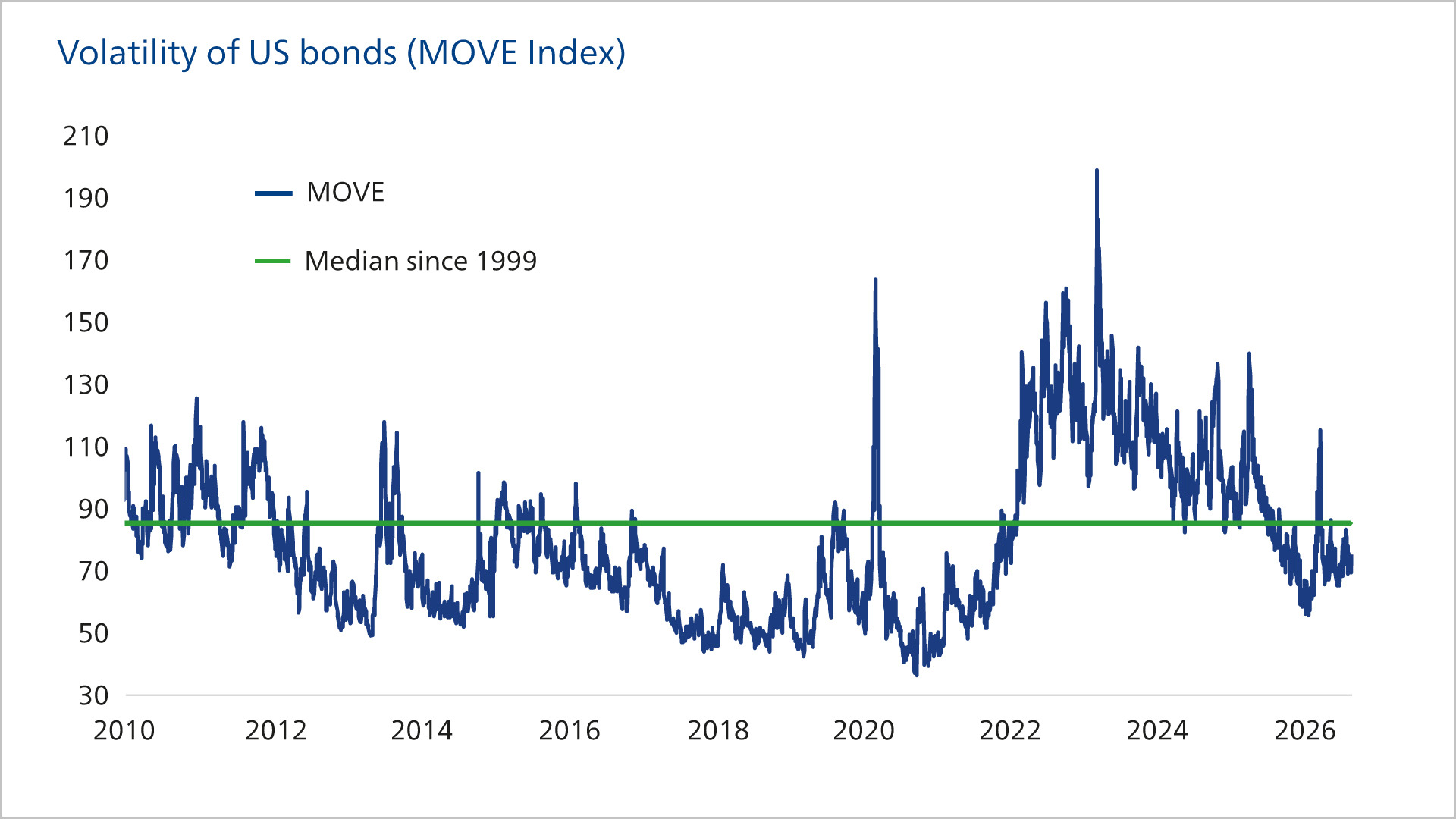
Source: Bloomberg, Union Investment. As at 31 August 2026
Capital market volatility remains subdued
Equity market volatility continues to decline
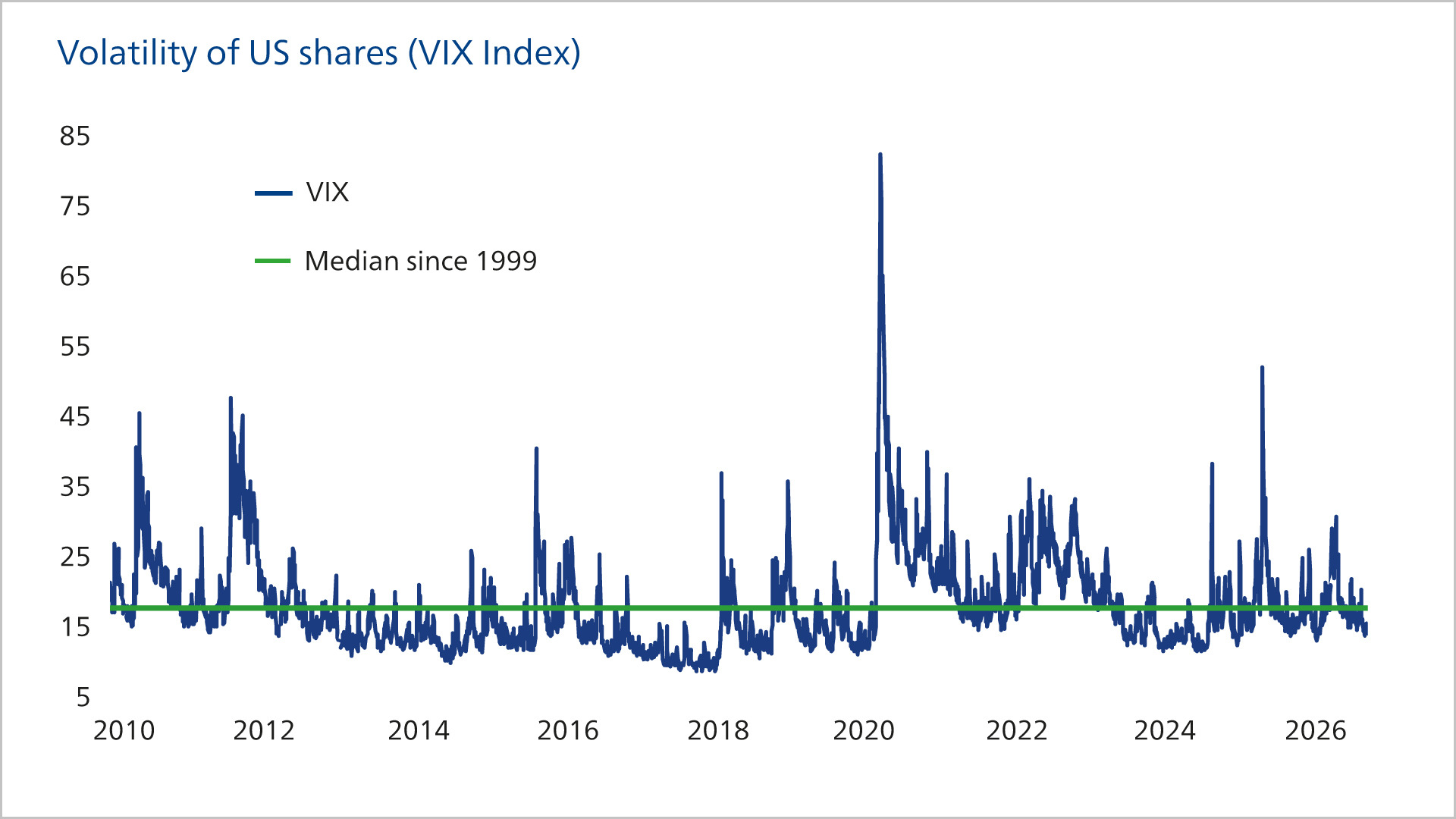
Source: Bloomberg, Union Investment. As at 31 August 2026
What forces are likely to drive markets in the coming months?
Tobias Schmidt: The economic environment is favourable, and the interim assessment for capital markets is correspondingly positive, especially for equities. Our economists expect the US economy to remain robust and able to absorb higher energy prices. In Europe, growth is gaining momentum, particularly in Germany, supported by stronger exports and fiscal stimulus that is increasingly feeding through to corporate balance sheets. In the Middle East, we do not expect an escalation, but rather a war of attrition, as sanctions against Iran take effect over time. Renewed hostilities could temporarily weigh on energy, equity and bond markets. However, we see this more as a price issue than a volume issue and do not expect sustained shortages. A severe winter would be unfavourable given Europe's tight gas reserves. Even then, however, the impact is likely to remain limited: we consider a recession or significant second-round effects on inflation to be unlikely.
|
65
In 2025, the Uppsala Conflict Data Program recorded 65 armed conflicts worldwide involving at least one state actor – the highest number since 1946. Thirteen of these were classified as wars, marking the highest level since 1992.
Particularly striking is the rise in direct conflicts between states: their number doubled for the second year in succession, from two in 2023 to four in 2024 and eight in 2025. |
Higher energy prices are fuelling inflation concerns. Do interest rates need to rise again?
Tobias Schmidt: Central banks are facing a dilemma: higher interest rates would put additional pressure on growth that is already being weighed down by expensive energy, especially in Europe. The interest-rate-sensitive construction sector would be particularly affected. Compared with previous meetings, the European Central Bank (ECB) now expects inflation to remain elevated for longer, albeit against a more positive growth backdrop. Following the rate move in September, another increase by the end of the year therefore appears likely. In the US, by contrast, price pressure from the import tariffs introduced a year ago, for example, is easing, meaning that the disinflation trend should remain intact. Rising market expectations of further rate hikes, together with high energy prices, prompted the Fed to raise its key interest rate in September. From a growth perspective, the picture in the US remains positive, although the energy-price situation continues to be more challenging. The simplest way to calm the situation would be for the US to return to a declaration of intent with Iran. If this were to happen soon, this single rate hike would probably be sufficient. Looking ahead, a sustained decline in core inflation could even allow Fed Chair Kevin Warsh to lay the groundwork for rate cuts by shifting the focus more strongly towards expected AI-driven productivity gains.
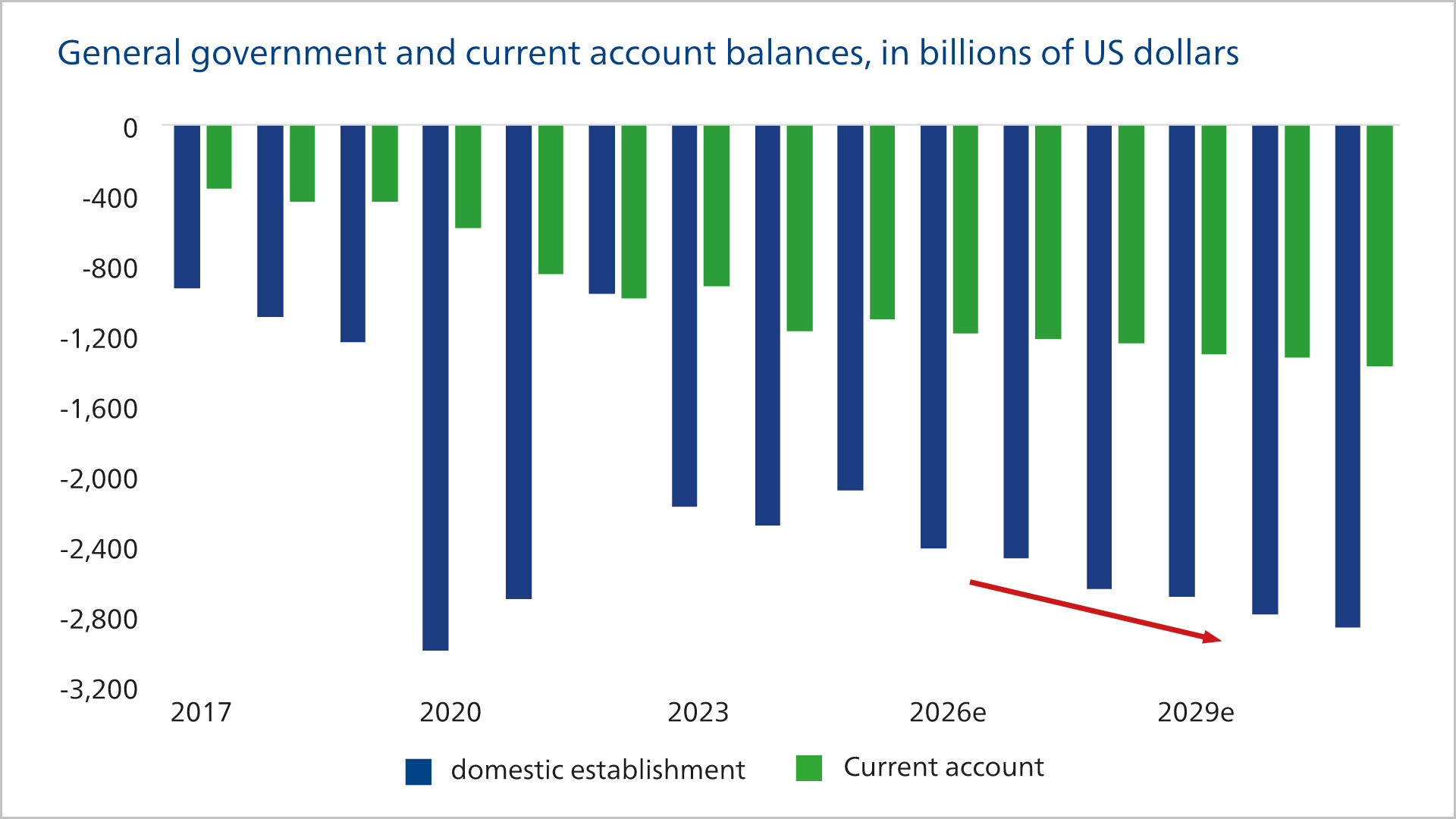
Rising government deficits and elevated funding requirements
'Permanent' deficits: the US example
Source: Bloomberg, Union Investment. As at 31 August 2026
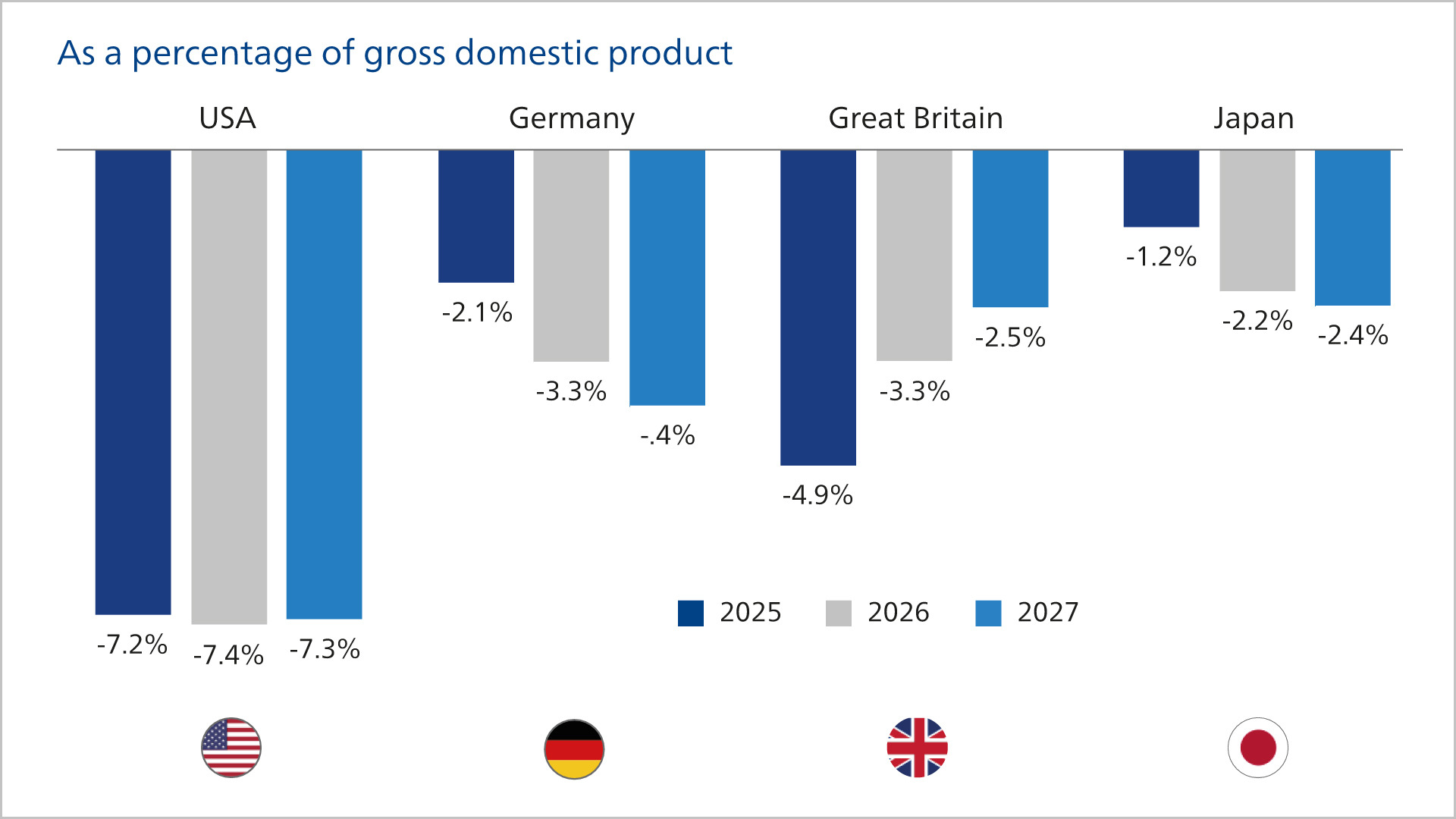
Rising government deficits and elevated funding requirements
High net borrowing requirements – particularly in the US
Source: Bloomberg, Union Investment. As at 31 August 2026
But rising government debt is driving yields in bond markets higher. Will this remain a headwind?
Tobias Schmidt: US debt remains a key factor. Further large-scale tax-cut packages in the style of the One Big Beautiful Bill now appear highly unlikely. At present, there are strong indications that the Democrats will win a majority in at least one, if not both, chambers of Congress. However, fiscal consolidation is not really conceivable even under this political constellation, not least because there is a degree of consensus that military spending will have to be increased following the recent geopolitical interventions. A rapid easing of debt dynamics therefore seems unrealistic. As markets have already largely priced this in, however, we do not expect a game changer for fixed income. What is needed is close duration and curve management. Corporate bonds with good to very good credit quality continue to offer attractive return prospects and remain a key portfolio component.
Looking at the equity side, the AI hype continues to play a role, while market concentration and debt levels are increasing. How are active asset managers responding?
Tobias Schmidt: AI remains a defining theme for equity markets, but it is a complex one. Neo-cloud providers and unprofitable technology companies point to signs of overheating. This trend is likely to prove short-lived; the bigger beneficiaries are more likely to be large, established companies in the cloud business, as well as semiconductor providers. The planned IPO of AI model provider Anthropic reflects expectations in the US financial market of sharply rising revenues. However, what is needed is not euphoria, but clear valuation discipline. Chip manufacturers trading on low double-digit price/earnings ratios do not look expensive given their strong revenue and earnings growth. But today’s winners are not automatically tomorrow’s winners. We cannot simply extrapolate past growth into the future. What matters most is active stock selection and a detailed understanding of the competitive landscape.
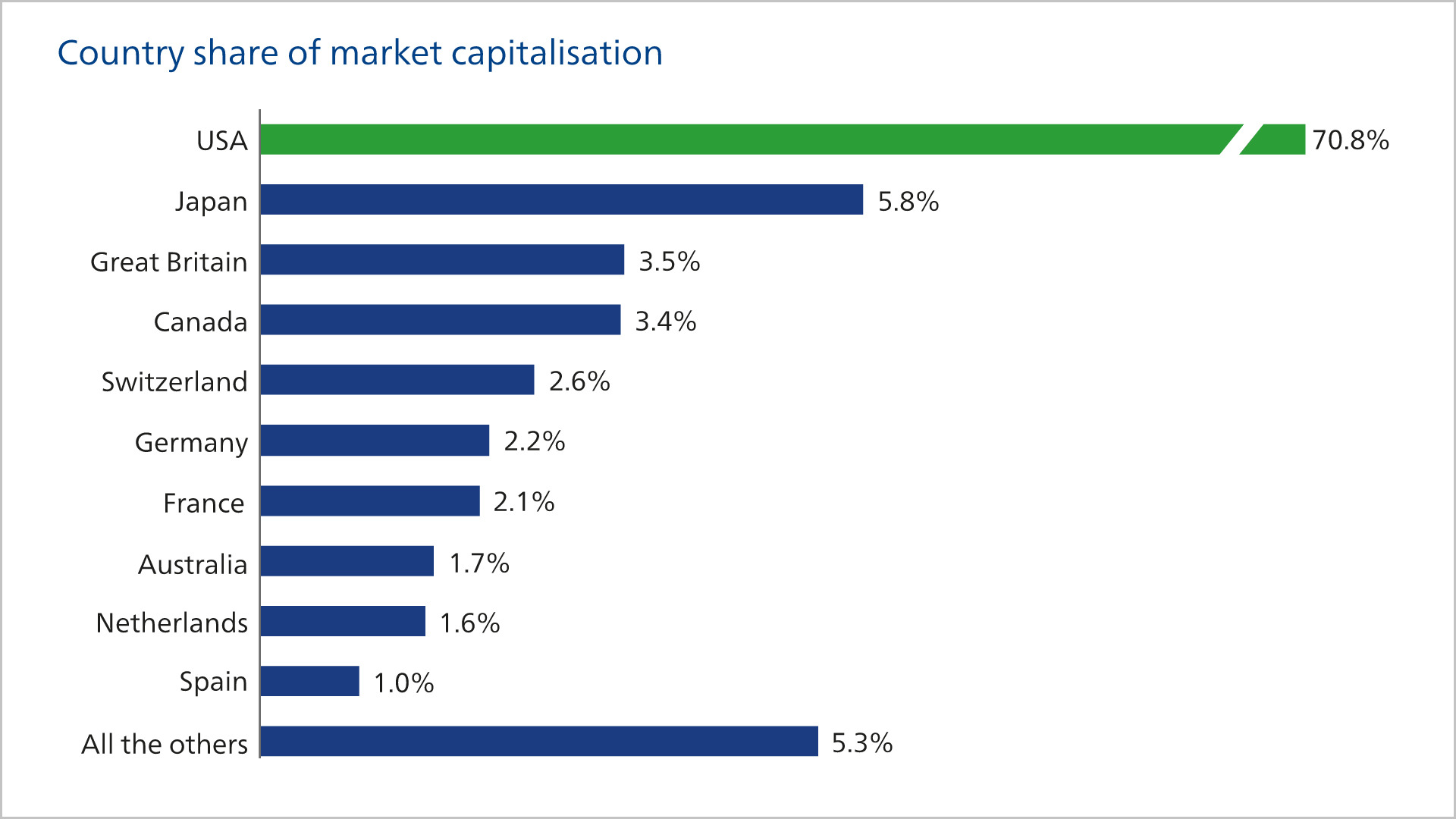
Equity market concentration is a key issue
MSCI World: US equities account for more than 70 per cent
Source: Bloomberg, Union Investment. As at 31 August 2026
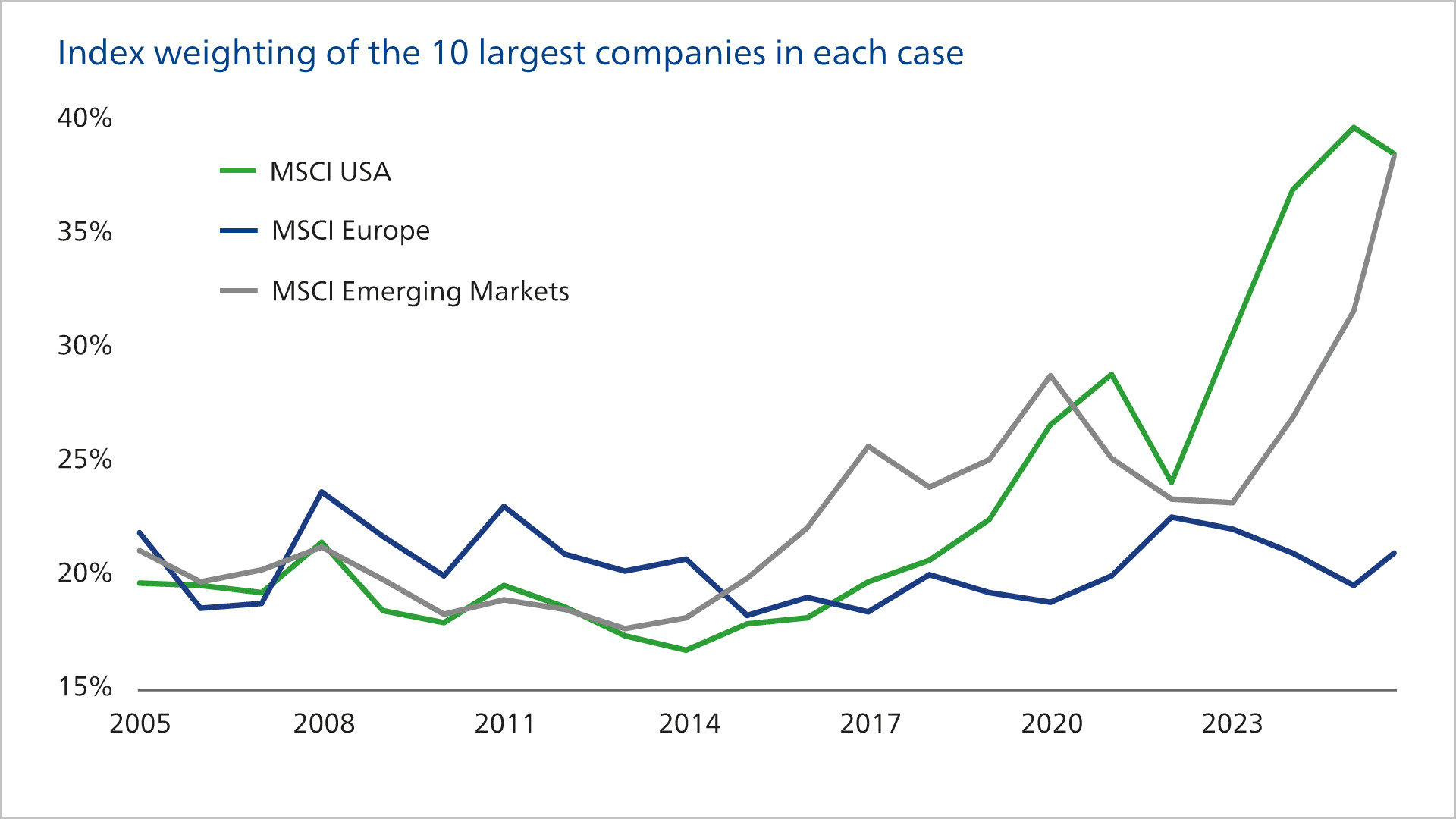
Equity market concentration is a key issue
High concentration in the US and emerging markets
Source: Bloomberg, Union Investment. As at 31 August 2026
Can concentration risk be limited?
Tobias Schmidt: Yes – through active diversification beyond the major equity indices. Other sectors are also likely to benefit from the use of AI, including European industrial companies that have so far lagged behind on the stock market. Broader diversification beyond the large US AI stocks – for example into themes such as energy efficiency, digitalisation, defence and infrastructure modernisation – is healthy and can help stabilise portfolios over the long term. It is important to make dependencies transparent, not to align risk budgets solely with index weightings, and to focus much more on the contribution that each asset class makes to overall portfolio risk, managing the portfolio accordingly.